Innovation No. 15 of 77 in the book
Counting by Tens
A base-10 number system carved into temple walls
- When
- c. 3000 BCE
- Dynasty
- 1st Dynasty
- Era
- Early Dynastic Period
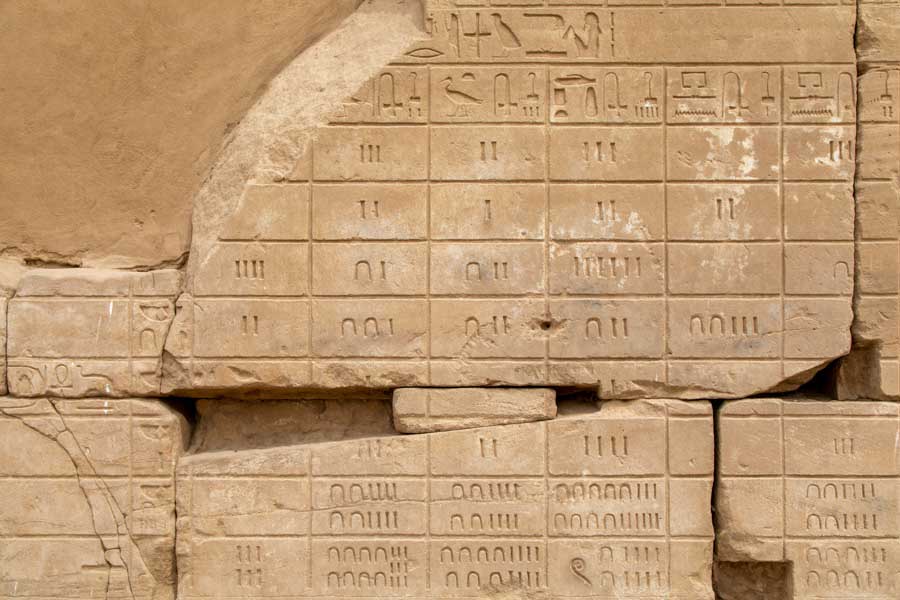
You count in tens because you have ten fingers — and Egypt built the first full written number system on exactly that, by around 3000 BCE.
They had separate signs for 1, 10, 100, 1,000, on up to a million: a stroke, a hoop, a coiled rope, a lotus, a man with arms raised. To write a number, you simply repeated the signs.
It was pure base-10, the same tens-and-hundreds logic behind every price tag and odometer today.
The decimal world started with ten Egyptian fingers.
The earliest evidence is the Narmer Macehead, a ceremonial limestone piece from the unification of Egypt around 3150 BCE, found at Hierakonpolis and now in the Ashmolean Museum, Oxford. Its inscription records figures of 120,000, 400,000 and 1,422,000. Egyptologists disagree over what event it commemorates — a campaign, a jubilee festival, or a royal wedding — but not over the notation, which is already a complete decimal system.
Frequently Asked Questions
How did the signs work?
One sign for each power of ten — a stroke for 1, a hoop for 10, a coiled rope for 100, a lotus for 1,000, up to a man with raised arms for a million. A number was written by repeating the signs as often as needed.
Is there later evidence the system was used in practice?
Yes. The Moscow Mathematical Papyrus, about 1850 BCE, and the Rhind Mathematical Papyrus, about 1550 BCE, show scribes working real problems in the same notation.