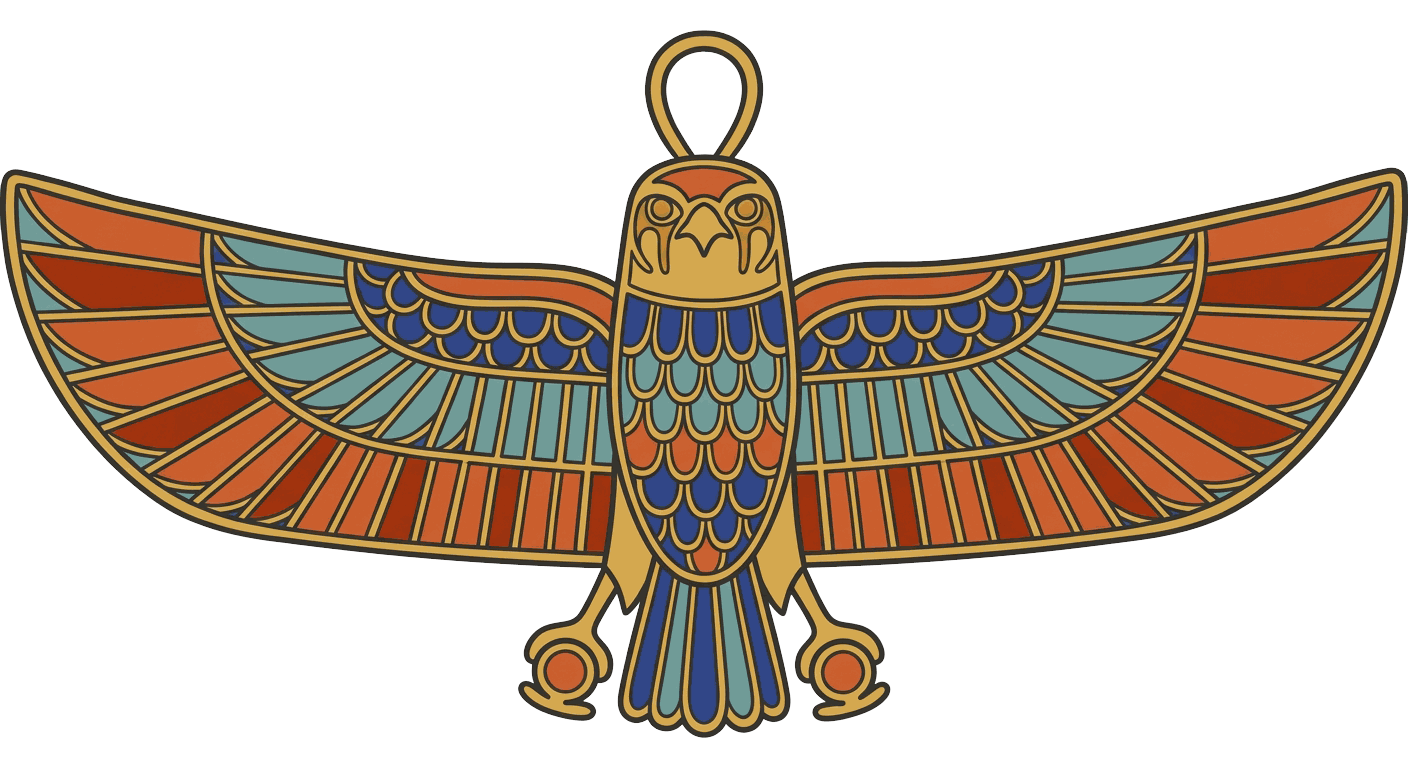
Innovation No. 16 of 77 in the book
Fractions
The Eye of Horus used as a system for dividing measurements
- When
- c. 1950 BCE
- Dynasty
- 12th Dynasty
- Era
- Middle Kingdom
Egyptians were doing serious arithmetic with fractions by around 1950 BCE, seen first in the Akhmim Wooden Tablet, and later worked out in detail in documents like the famous Rhind Mathematical Papyrus.
Their system was unusual: nearly every fraction was built by adding up unit fractions — 1/2, 1/3, 1/4. Ready-made tables helped scribes split loaves and wages exactly.
A neat legend ties the halving fractions (1/2, 1/4, 1/8…) to the pieces of the sacred Eye of Horus. Historians treat that as a later story, not the true origin — but the math itself was real, and first.
The first people to compute confidently with fractions were Egyptian scribes.
The system is already complete on the Akhmim Wooden Tablet, around 1950 BCE, which works through the halving of grain measures. The same method reappears four centuries later, at length, on the Rhind Mathematical Papyrus — the better-known document, but not the earlier one. Both measure grain in heqat, the standard dry unit of about 4.8 litres.
Frequently Asked Questions
What was the halving series actually for?
Measuring grain. Scribes worked down from a half to a quarter, an eighth and on to a sixty-fourth of a heqat, which gave a standard, checkable set of portions for wages, rations and tax.
Do the fractions come from the Eye of Horus?
Almost certainly not. Historians of science now read the signs as practical scribal shorthand for dry-volume measures. The link to the pieces of the eye looks like a later story told about an older system.