Innovation No. 48 of 77 in the book
The Hand Mirror
Polished bronze used as a personal mirror
- When
- c. 1800 BCE
- Dynasty
- 12th Dynasty
- Era
- Middle Kingdom
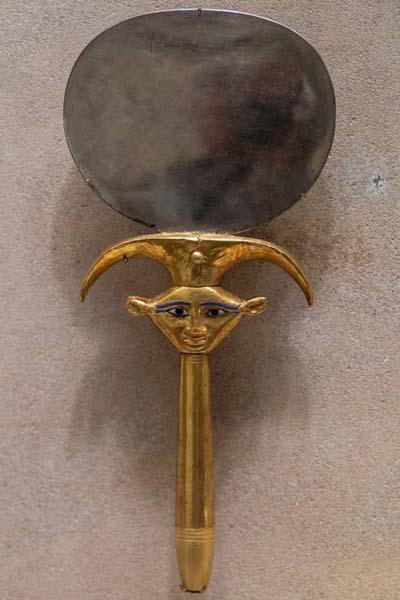
Before glass mirrors there was polished metal — and Egypt was casting fine bronze hand mirrors by around 1800 BCE, in the Middle Kingdom.
A disc of bronze, buffed to a bright shine, was set on a carved handle often shaped like a papyrus stalk or the goddess Hathor. The round face deliberately echoed the sun’s disc.
It was a genuine daily object — used for the makeup and grooming Egyptians took so seriously — and a thing of beauty in its own right.
The personal mirror you check each morning has an Egyptian ancestor.
The earliest metal mirrors in the record are copper disks from Old Kingdom burials, roughly 2686 to 2181 BCE. The polished bronze mirror is the Middle Kingdom refinement of that older copper form, and it turns up in men's tombs as often as women's — worth noting, because grooming goods are often assumed to be female by default.
Frequently Asked Questions
Why is the disc not perfectly round?
It is flattened slightly wider than tall, to echo the shape of the rising sun. Polished bronze takes a warm golden sheen, which was read as the light of Ra — so the object doubled as a small sun held in the hand.
What were the handles made of?
Wood, faience, ivory or bronze, usually carved as a papyrus stalk for fertility and youth, or as the face of Hathor, goddess of beauty and joy. Looking into the mirror meant looking through the goddess.